

Imagine this: It’s 11 PM on Sunday evening and you suddenly recall that monstrous project due the next morning. Three chapters to read, math homework to complete and that essay you haven’t started: Your heart pounds as the clock ticks. Sound familiar? If you’re nodding in agreement now, don’t fret — you’re not the only one. So, not to worry: the ability to manage your time is a skill that can be learned and practiced.
Time management doesn’t mean turning you into a robot, rigidly following rules every second of your daily schedule. It’s about using your hours wisely, so you can work efficiently, but also have time to do the things you’ve always wanted to do (like walking on a tightrope and trapezing!) hang out with friends and get enough sleep. By managing your time effectively, you could also achieve better grades, reduce stress at school and find extra time to pursue the hobbies and activities you enjoy.
In this guide, you’ll also learn tangible, real-life strategies that work for students. No elaborate systems or fancy apps required — just straightforward strategies you can implement today, so you can start taking control of your time and killing your goals.
The Importance of Time Management for Students
Before we get to the tips, let’s discuss why this is important. You suck at everything because you manage your time poorly. Your grades fall because you are speeding through your assignments. You’re always behind, so you stress. Your friendships take a hit because you have too much catching up on to actually hang out. Not to mention your health for those late-night test-cramming sessions.
Conversely, effective time management is a virtuous cycle. You complete homework on schedule, you have less stress, you can sleep better, which gives you the energy to stay sharp in class. There are sports, there is music, there is art or whatever makes you happy. You can say “yes” when your friends want to go out now, that you aren’t drowning in overdue work.
The skills you learn will also benefit you for a lifetime. Your college, jobs, relationships—basically everything gets easier when you have control over your time.
Understand What Really Matters
The first step in creating a schedule that works is to decide what’s worth focusing on. And not everything is equally important. You try to treat everything as if it were equally important, and your brain explodes.
Distinguish between the Important and the Urgent
There are things that feel pressing, but aren’t actually so important. That group chat with a billion memes exploding? Feels like a crisis, but it’s not. On the other hand, Friday’s math test may not seem very urgent on Monday, but it certainly is important.
Here’s an easy way to understand it:
Critical and Time Sensitive: These belong on the top of stack. Examples: studying for a test the next day, completing homework due that day, finishing a project.
Important but Not Urgent: Put these in your calendar. Examples: beginning on a long-term project, reviewing notes after class, reading material ahead in your textbook.
Urgent but Not Important: These tasks should be reduced as much as possible. Examples: seeing every text message pop up and responding, checking in on social media comments ahead of your face-to-face time, addressing drama that has nothing to do with you.
Not Urgent and Not Important: Ditch these or put in the vault for true free time. Examples: watching random videos, scrolling without stopping through social media feeds, playing games you don’t want to play just because you have something else to do.
Write Down Your Goals
You have to know where you’re headed before you can identify how to reach it. In just five minutes, write down your goal(s) for the semester or school year. Keep them specific and realistic.
Instead of “Get better at math,” for example, make it “Raise my math grade from a C to a B by the end of the semester.” Instead of writing, “Be healthier,” try something specific like “Exercise for 30 minutes three times per week.”
It is easier to know what you value and how to allocate your time when you have such clear goals. Is scrolling through Instagram helping you achieve your goals? Probably not. Is it putting 20 minutes into reading your biology notes? Absolutely.
Make a Schedule That Works for You
Now that you know what is important, it’s time to make a schedule. And don’t worry, I’m not talking about planning every minute. It is about building an infrastructure that keeps you on the right course, while not hemming you in.
Want to make your resume stand out in 2025? How to Write a Professional Resume in 2025.
Start with the Non-Negotiables
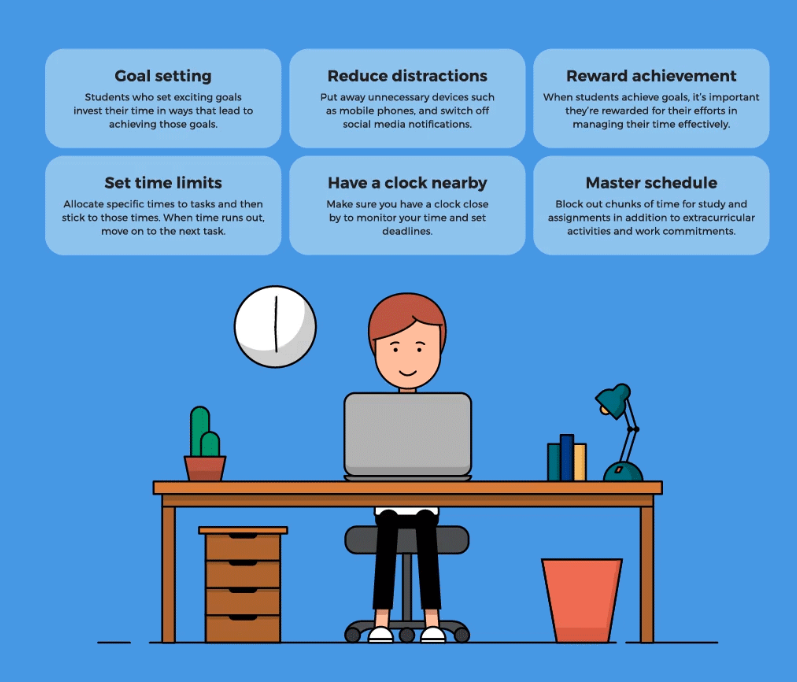
Start by blocking the time you cannot change. School hours, sports practice, music lesson, family dinner, sleep — these are your anchor points. Everything else fits around them.
Nearly all students require 8-10 hours of sleep a night, though few get it. If you need to get up by 6:30 am, be in bed no later than 10 p.m. Yes, really. There is no sleeping in — your brain needs all that day’s learning time to process.
Create Time Blocks for Homework
Rather than saying “I’ll do it later,” determine when exactly that “later” will be. Perhaps it is right after school for 90 minutes. Perhaps it’s 7-9 p.m., post dinner. Having a consistent routine is more important than getting the time exactly right.
Here’s an example schedule for a week:
| Time | Monday | Tuesday | Wednesday | Thursday | Friday |
|---|---|---|---|---|---|
| 3:00-4:30 PM | Soccer practice | Homework time | Soccer practice | Homework time | Free time |
| 4:30-6:00 PM | Homework time | Free/relax | Homework time | Free/relax | Friends/activities |
| 6:00-7:00 PM | Dinner & family | Dinner & family | Dinner & family | Dinner & family | Dinner & family |
| 7:00-8:30 PM | Homework/study | Homework/study | Homework/study | Homework/study | Free time |
Notice there’s flexibility built in. It’s not scheduled by the minute, but the important stuff has a place.
Use Sunday for Planning
Take 15 to 20 minutes every Sunday evening to lay eyes on the week ahead. If you don’t have your agenda, use the school’s portal or planner to look for upcoming tests, projects and assignments. If you have a test on Thursday, set aside extra study time for Tuesday and Wednesday. If you have a big project due Friday, work on it in small increments Monday through Thursday instead of all at once Thursday night.
Trim Big Jobs Down to Manageable Steps
Big projects are overwhelming, which is why we procrastinate them. The solution? Shatter them into tiny fragments, so that each seems simple.
Perhaps you have a five-page research paper due in three weeks. That sounds huge and scary. But what if you unpacked it this way?
Week 1:
- Day 1: Select the topic and get approval to use it
- Day 2: Locate three strong sources
- Day 3: Source reading and notetaking
- Day 4: Create an outline
Week 2:
- Day 1: Write the introduction
- Day 2: Write body paragraph one
- Day 3: Write body paragraph two
- Day 4: Write body paragraph three
- Day 5: Write the conclusion
Week 3:
- Day 1: First draft of everything
- Day 2: Revising for content and organization
- Day 3: Editing for spelling and grammar
- Day 4: Do citations and bibliography formatting
- Day 5: Final proofreading + submit!
Notice how much less frightening that sounds? We each take one of these tasks, which each take 30-45 minutes, instead of trying to get everything done in a torturous never ending all nighter.
Beat Procrastination Before it Beats You
Procrastination is every student’s enemy. We all do it, but successful students learn how to combat it.
The Five-Minute Rule
Promise yourself you’ll tackle something for just five minutes. No more, no less. Set a timer if you need to. If you can start, you’re most of the way there. Once you make it five minutes, the chain keeps rolling because you’re already in the flow.
Remove Temptations
Your phone is likely your biggest distraction. Keep it in another room, turn it off or use an app that blocks social media during homework time. (You can’t scroll through TikTok if your phone is out of reach.)
The same thing applies to your computer. If you are writing an essay, close all tabs; just put up the tab that you’re working in. Make your notifications go away. Make it difficult for yourself to get sidetracked.
Reward Yourself
Reward yourself for completing tasks. “Once I complete this chapter, I can go watch one of my favorite shows.” “I get to play video games for 30 minutes after I finish my math homework.”
The reward is supposed to come after the work, not before. And be sure the reward doesn’t disrupt all of your schedule. Watching one episode is fine. Binge-watching the season is not.
Master Your Study Sessions
Effective studying isn’t about the time you put in, it’s about what you put in that time.
Use Active Learning Techniques
Reading your textbook again and again is not studying — it is just reading. Your brain has to engage with the information for it to stick.
Try these instead:
Practice questions: Particularly useful for math and science. Read the examples not to look for what you shouldn’t do, but take time to actually do the problems yourself.
Use flashcards: They work for vocabulary, dates, formulas and putting those things into the brain’s hard drive. Quiz yourself regularly.
Teach someone: Describe the idea to a friend, parent or pet. If you can teach it, then you know it.
In your own words: A section of a book is read and then the book is closed; pupils will recall what they have read and jot down the main points without looking.
Take Smart Breaks
Your brain can’t focus forever. Taking frequent breaks can help you learn better, researchers have found.
Experiment with the Pomodoro Technique: Pull 25 minutes of focused work, then take a five-minute break. And after three more rounds, a longer, 15- to 30-minute break. During your breaks, stand up, stretch, have a snack and do something totally unrelated to the thing you were studying.
Don’t check social media on your break unless you have godlike willpower. It’s so easy to get drawn in for 20 minutes when you planned on only 5.
Study Smarter, Not Harder
Last-minute cramming is not effective. Your brain is trying to absorb and then store information. It’s much more effective to study a little bit every day than binge-study.
If you have a test on Friday, begin study on Monday. Spend 20-30 minutes reviewing the material each day. You don’t have to be in panic mode. You’ll be fine by Friday instead of freaked-out.
Also, when your brain is fresh, that is the time to study the most difficult material. If you’re a morning person, learn calculus before lunch. If you’re a night person, reserve your most challenging work for after dark when you’re most alert.
Physical and Mental Health is Important
Time management isn’t just about cramming more work into your day. It’s also about ensuring that you’re healthy enough to actually do that work.
Prioritize Sleep
We’ve written this before, but it’s worth repeating: Sleep is not a negotiable luxury. You do everything at a slow-motion pace when you’re sleep-deprived. You can’t concentrate in class, you make thoughtless errors on homework and you have to read things several times before they make sense.
This is one of the time management strategies that will save you the most time because it makes you more efficient.
Eat Regular Meals
It might seem like a worthwhile trade to skip breakfast in favor of an extra 15 minutes of sleep. Your body is running off fuel, and that fuel is food. It’s important to eat three meals a day, and you can even have healthy snacks nearby so you don’t feel bad when you’re hungry while studying.
Make Time for Exercise
When you’re busy, exercise can feel like a luxury you don’t have time for, but it actually helps you manage your time better. Plus, exercise is an effective stress reducer, improves focus and gives you extra energy. A 20-minute walk, even if it takes you away from optimal work time, will make your thinking more productive.
Don’t Forget to Relax
No work and all play leaves you unfulfilled and bored. Include in your schedule time for fun, hobbies and hanging out with friends. This isn’t lost time — it’s very much-needed time that allows you to check out for a bit and recharge, so you can be as productive as possible when it’s work time.
Leverage Organization Tools and Systems
You don’t need high-tech gizmos to manage your time, but a few special gadgets can help you make better use of your days.
Keep a Planner
Whether you use a paper planner, an app or a website, get everything — every assignment, test date and extracurricular activity — into your calendar the very moment you become aware of it. Check your planner every day. That way you don’t forget things and can plan accordingly.
Use a To-Do List
In the mornings or even the evening before, write out what you plan to do that day. Keep the list small — go for 3-5 important things. Cross out each item as you do it. It’s just so satisfying to have all those checkmarks roll in.
Try Time Tracking
Track what you actually do with your time for one week. You may find that you end up spending two hours a day on social media or 45 minutes searching for things just because you’re disorganized.
Once you know where your time is going, you can make better choices. Perhaps you don’t really need to watch YouTube for an hour after school. Perhaps you can put that time toward homework and then have the entire evening free.
Learn to Say No
I know it’s rough, but remember: You can’t do all of the things. You can’t fit 20 pounds of stuff into a five pound bag.
If you’re already inundated with schoolwork and you play on two sports teams, maybe don’t join three clubs as well. It’s better to do a few things well than to spread yourself like water, so covered by everything that you’re stressed and exhausted all the time.
Saying no does not mean you are lazy or you are a slacker. It means you’re being sensible about what you can actually manage.
Deal with Time Wasters
Some of those things are time wasters, they don’t provide you with anything valuable back. These are the biggest offenders and how to manage each:
Social Media
It’s designed to be addictive. You open it to look at one thing and, boom, 45 minutes have passed. Schedule times to look at social media — 15 minutes at lunch and then 20 minutes in the evening. The rest of the time, keep it closed.
Multitasking
You think you’re being efficient working on your homework while the TV is going and you’re texting with friends, but really everything is done poorly. Twice as long to do your homework, and with more errors. You don’t enjoy your show because you’re not truly watching it. And your conversations are superficial because you’re distracted.
Do one thing at a time. You’ll be done sooner and do a better job.
Perfectionism
Perfectionism is procrastination in disguise. You invest three hours on a homework that only counts 10 points because you want to make it perfect, perfect. And your big 30% capstone project? Idle there.
Aim for excellence, not perfection. Do your best work in a reasonable amount of time and then move on.
Cater Your Plan to Real Life
Life throws curveballs even when you manage your time perfectly. You get sick. A family emergency happens. Your teacher gives you an impromptu project.
When this happens, don’t panic. Then, take a look at your schedule and determine what you can tweak. Can you request an extension for anything? Is there a way you can spend less time on lower-yield tasks? Could someone help you get caught up?
You’re not trying to develop a perfect schedule that never needs to be changed. The idea is to be structured enough that you can handle the unexpected without everything falling apart.
Build Better Habits Over Time
You’re not going to become an expert at time management overnight. These are habits you grow a little bit at a time.
Start small. Choose one or two of these ideas from this article to work on in the next two weeks. Maybe you’ll begin to keep a planner and schedule a regular time each day for homework. When those begin to feel like a natural part of your day, add another habit.
Be patient with yourself when you screw up — and you will screw up. Everyone does. The key is to learn from it and keep trying.
The Actual Secret to Getting More Time
Here’s the reality: managing time is not really about managing time. You can’t add hours to the day. What you can control is yourself — your decisions, your habits, your priorities.
The students who appear to have it all figured out are not superhuman. They’ve simply realized what matters to them most of all and scheduled their lives accordingly. They’ve found ways to get an early start, shield themselves from temptation and take care of their well-being.
You can do this too. Every day for you is an exercise in this, but with every one that you do it, it’ll get easier. Eventually, these strategies become automatic. You won’t have to think about them at all — they’ll just be part of the way you run things.
And when it does, school is so much less stressful. You’ll have your time back to do what you love! You get better grades because you’re not just rushing through everything. You will sleep better (really!) with your work done.
More than anything, you’ll feel in charge of your life rather than always responding to whatever crisis comes up next.
So start today. Choose one piece of advice from this article and put it into practice this week. Then add another next week. Before you know it, you’ll be that student who has time for everything — the one everyone else envies and says, “How do you do it all?”
The answer? Good time management. And now you know how.
Frequently Asked Questions
How long should I do homework for every night?
It varies by grade level and specific courses, but one rule of thumb is 10 minutes per grade level. So if you are in 9th grade, figure on two hours of homework a night. If you are consistently spending far more than this, make sure to bring up these numbers with your teachers or school counselor as well for tips on how to work faster.
What if I have too many extracurriculars to make homework time?
You may have to cut back on activities. It’s better to do two things very well than five things poorly at the expense of your grades. Honestly, what is most important on your schedule? Something else to keep in mind: use small pockets of time—if you have 30 minutes between activities, that’s enough to knock off a bit of homework.
Is it okay to study with music?
It all depends on the music and the job. Some may be able to focus better with instrumental music or lo-fi beats. But music that has lyrics can be distracting — especially when you’re reading or writing. For rote learning, music might be okay. One such strategy: For complex thinking, silence or very quiet background music typically does best. Experiment until you find your preferred combination.
How do I stop my phone from distracting me?
Distance works best. Leave it in another room, hand it over to a parent during homework time or power it down altogether. Apps that temporarily block social media can also be useful. The trick is to make it so hard to get at, you won’t check on autopilot.
But what if I’m already behind on everything?
First, don’t panic. List everything you need to do. Take the temperature of your teachers on what you have to get done, whether you have wiggle room and if some deadline extensions are in order. Instead, work to catch up on the most pressing things first—tests and large projects ahead of small homework. Ongoing, leverage the planning tactics of this piece so you don’t find yourself behind again.
How far in advance should I begin studying for a big test?
For big tests, at least a week in advance. Two weeks for final exams. Develop a study agenda that segments the material into blocks. One method is to go through a certain number of chapters a day, and dedicate the last few days solely to practice problems and studying problem areas.
What if my schedule is never the same two weeks in a row?
Develop a loose structure instead of a tight schedule. You know certain things will never go away — school, sleep, meals. For the rest of your tasks you should work out what to do during a weekly planning cycle on Sunday. See what you have going on that week, and schedule homework time around it. It’s just a matter of still planning ahead, even if that plan changes week by week.
How can I read with more concentration?
However, if you find that same textbook a perfect remedy for insomnia, diverse resources can prevent monotony in your study routine and inspiration from outside the scope of your required readings may give a boost to how well you learn. And study your hardest subjects when you feel most awake, and save the easier ones for when your energy is lower.
Is it permissible to study different matters in one study session?
Yes, and it may actually help! Changing topics keeps your brain on its toes. Just see that you avoid rationing the time any subject should have. Consider trying 30-45 minutes of sustained focus on a subject, followed by a short break and then moving to another subject. But don’t switch too often — rapid toggling is what makes deep focus so hard to settle into.
What do you do if you’re doing all these things and yet still feeling overwhelmed?
Speak to someone — parent, school mental health provider or teacher. If you always feel overwhelmed even though your time management is decent, this could point to an issue with pressure, study skills, anxiety or all three. You are not weak for asking for help and the adults in your life want to help you.